
Maple Syrup and the Satellite Moth
Before we get into the usual content, a quick note: if you're looking for a reason to get out of the house next Thursday, April 9th, Teens to Trails is hosting its annual fundraiser, Bow Ties and Bean Boots, at Allagash Brewing Company in Portland. It's a great evening and a great organization.
Now, on to Maple syrup.
Top of Mind
Every spring, I tap a few of the maple trees on our property and boil the sap down into syrup. It is, in almost every way, the opposite of tax season.
We have mostly pine trees on our land, as most coastal Maine properties do, but there are a few scattered red maples. Red maples aren't as productive as sugar maples. The sap has lower sugar content, which means more boiling, and the season window is a little shorter. For a hobbyist making a gallon or so, none of that matters much.
The science of it is simple and satisfying. Maple sap flows when daytime temperatures climb above freezing and nights drop back below it. The freeze-thaw cycle creates pressure changes inside the tree that push sap toward the taps. Too warm, and the tree starts to bud, which turns the sap bitter. Too cold, and nothing moves. There's a narrow window in late March and early April when conditions are just right, and you don't really control it. You just pay attention and show up.
This year we built a homemade evaporator, which has been a genuine improvement. But the upgrade doesn't change the fundamental nature of the work: you boil, and you wait. Fifty gallons of sap makes about a gallon of syrup, and you get there by maintaining a steady boil for several hours and not rushing it. That's the whole job.
I find this deeply relaxing in a way that's hard to explain to someone who's never done it. Tax work is all details, decisions, and documents. Maple syrup is just heat and patience. There's no code section to interpret. Nobody calls me in the middle of a boil to ask about a K-1. The steam goes up, the liquid reduces, and eventually you have syrup. It's a good reminder that not everything worth doing is complicated.
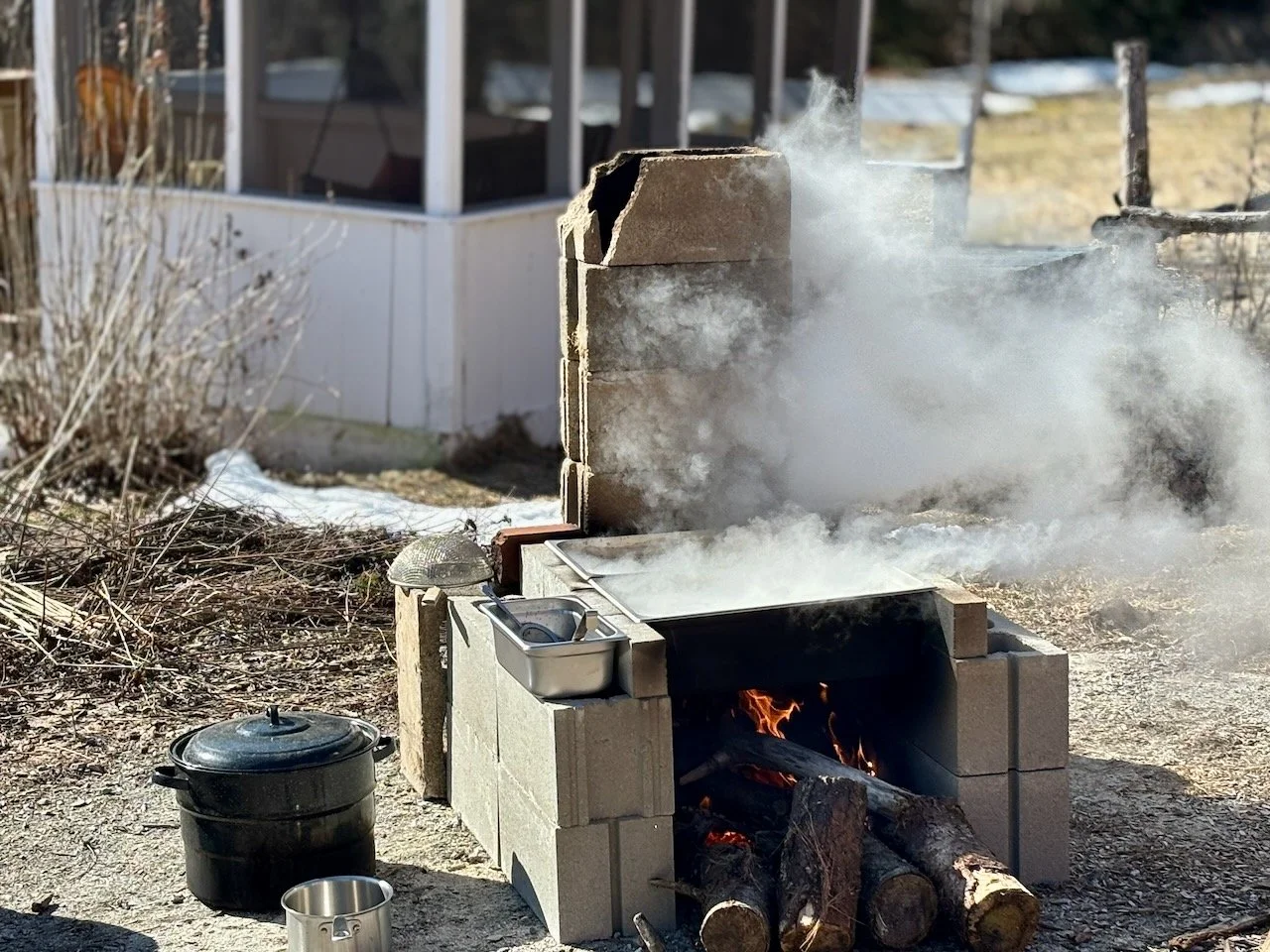
Our homemade evaporator in action
Worth Knowing
Since I'm writing about a hobby, this seems like a good moment to cover hobby loss rules, because the IRS has opinions about the difference between a hobby and a business, and those opinions have real tax consequences.
The distinction matters because business losses are deductible. Hobby losses are not. If you run a legitimate business and have a bad year, the loss can offset other income. If you have a hobby that generates some revenue, you report the income, but after 2017 you generally can't deduct the expenses against anything. That asymmetry is worth understanding.
The IRS uses a facts-and-circumstances test to draw the line, with a few factors that tend to matter most: whether you conduct the activity in a businesslike way, whether you depend on it for income, whether you've made a profit in prior years, and whether the losses are beyond your control or are typical for the startup phase of the type of business you're in. There's also a presumption that if an activity produces a profit in at least three of five consecutive tax years, it's probably a business. Not a guarantee, but a useful safe harbor.
Where this becomes consequential is when a side activity starts generating real revenue. Etsy shops, photography, consulting work on the side, rental income from a vacation property. If you're making money from something you also genuinely enjoy, it's worth thinking about whether you're treating it like a business or a hobby, because the IRS will eventually form its own view, and it's better to have thought it through in advance.
My maple syrup operation fails the business test on every dimension, and I'm at peace with that. I have no profit motive. I sell nothing. My ROI, if you account for the time and the materials, is spectacularly negative. It is a hobby, unambiguously, and the gallon of syrup I end up with is worth every bit of the effort regardless of what the tax code thinks about it.
Mark Your Calendar
April 15th. April 15th. April 15th.
If your return isn't ready and you need more time, extensions are available and they exist for a reason. An extension gives you until October 15th to file the return. It does not extend the time to pay any taxes owed. If you think you'll owe, it's worth making an estimated payment by April 15th to minimize interest and penalties.
If you're a Flying Point client and haven't submitted your tax documents yet, or got them to us late in the season, we'll be filing an extension on your behalf. You'll hear from me separately about next steps. Reach out if you have any questions.
Maine Wildlife Facts
Will has always had a deep affection for birds. Frank gravitates toward apex predators, which longtime readers may recognize as a consistent pattern. And Catherine, now 2 and officially a junior associate on the team, appears to have staked out her own territory: bugs.
It is not unusual to hear her say "See buggy?" while pointing with great enthusiasm at something small and crawling. She has been particularly delighted by the sap buckets, which attract insects drawn to the sugar. We've been seeing small moths visiting the collection buckets regularly, and after some research, the leading candidate is the Straight-toothed Sallow moth (Eupsilia vinulenta). I want to be transparent that I am not an entomologist, and the junior naturalist doing most of the field identification is two years old, so we're holding this ID loosely.
That said, the Straight-toothed Sallow would make a lot of sense. These moths are one of the few species in the northeast that overwinter as adults rather than eggs or larvae, emerging from hibernation on mild late-winter days when temperatures climb above freezing. They're known to seek out sugar sources in early spring, and one researcher documented them visiting maple sugaring operations specifically. The moths mate in late winter and early spring, nectaring on early tree flowers like red maple. If you're running sap buckets and finding moths in them, these are a plausible culprit.
They also apparently go by an alternate common name: "the Satellite," which comes from the small spots that seem to orbit the larger spot on the forewings. Will has already decided he prefers that name. Honestly, fair enough.
These Maine wildlife facts have been brought to you by Will (7), Frank (4), and Catherine (2), Flying Point Advisors' on-staff naturalists.
Questions about any of this? Just reach out - I read every email and love hearing from you. Thanks for reading. You'll hear from me again in about two weeks.
-Mike
Thumbnail photo: allenbryan / iNaturalist (CC BY-NC 4.0)
Disclaimer
The Flying Point Update is provided for general educational and informational purposes only. The content in this newsletter reflects my thoughts and observations on tax, accounting, and financial planning topics, but should not be considered personalized tax, accounting, or investment advice for your specific situation.
Tax laws are complex and change frequently. The information presented here is based on current tax law as of the publication date and represents general concepts that may not apply to your circumstances. Every individual and business has unique factors that affect their optimal tax and financial planning strategies.
Before making any financial decisions or implementing any tax strategies discussed in this newsletter, please consult with a qualified tax professional, CPA, or financial advisor who can evaluate your specific situation. If you'd like to discuss how any of these topics might apply to your circumstances, I'm always happy to chat.